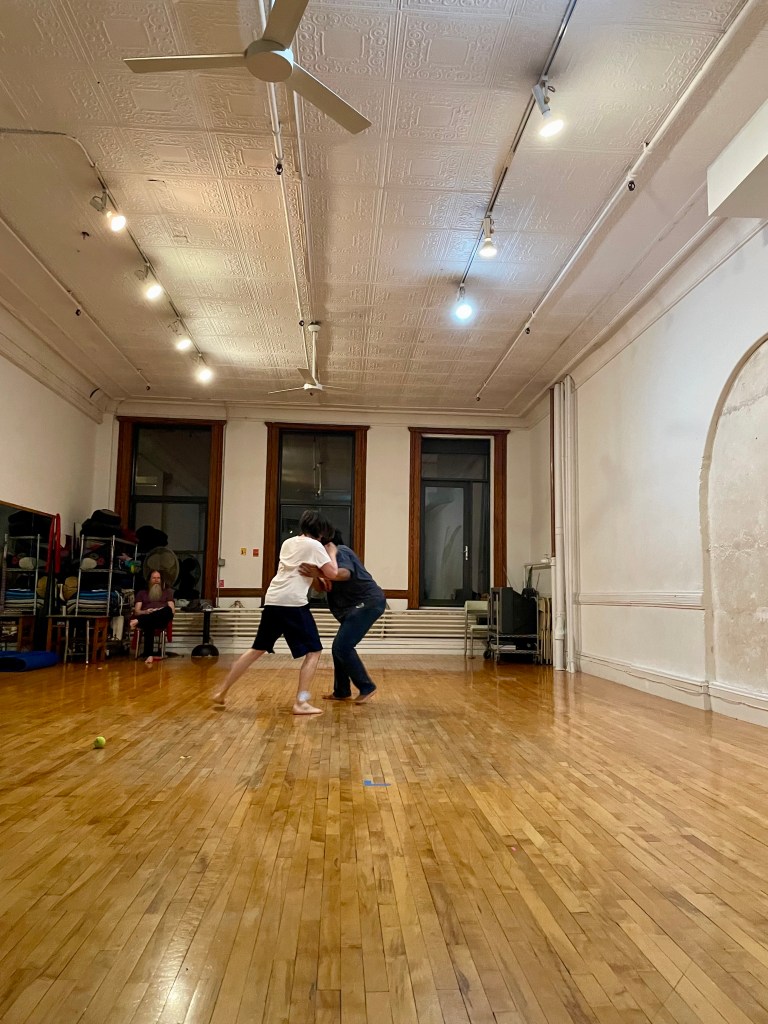
While weekend classes are on pause for the summer, Push Hands Now happily presents: practice…
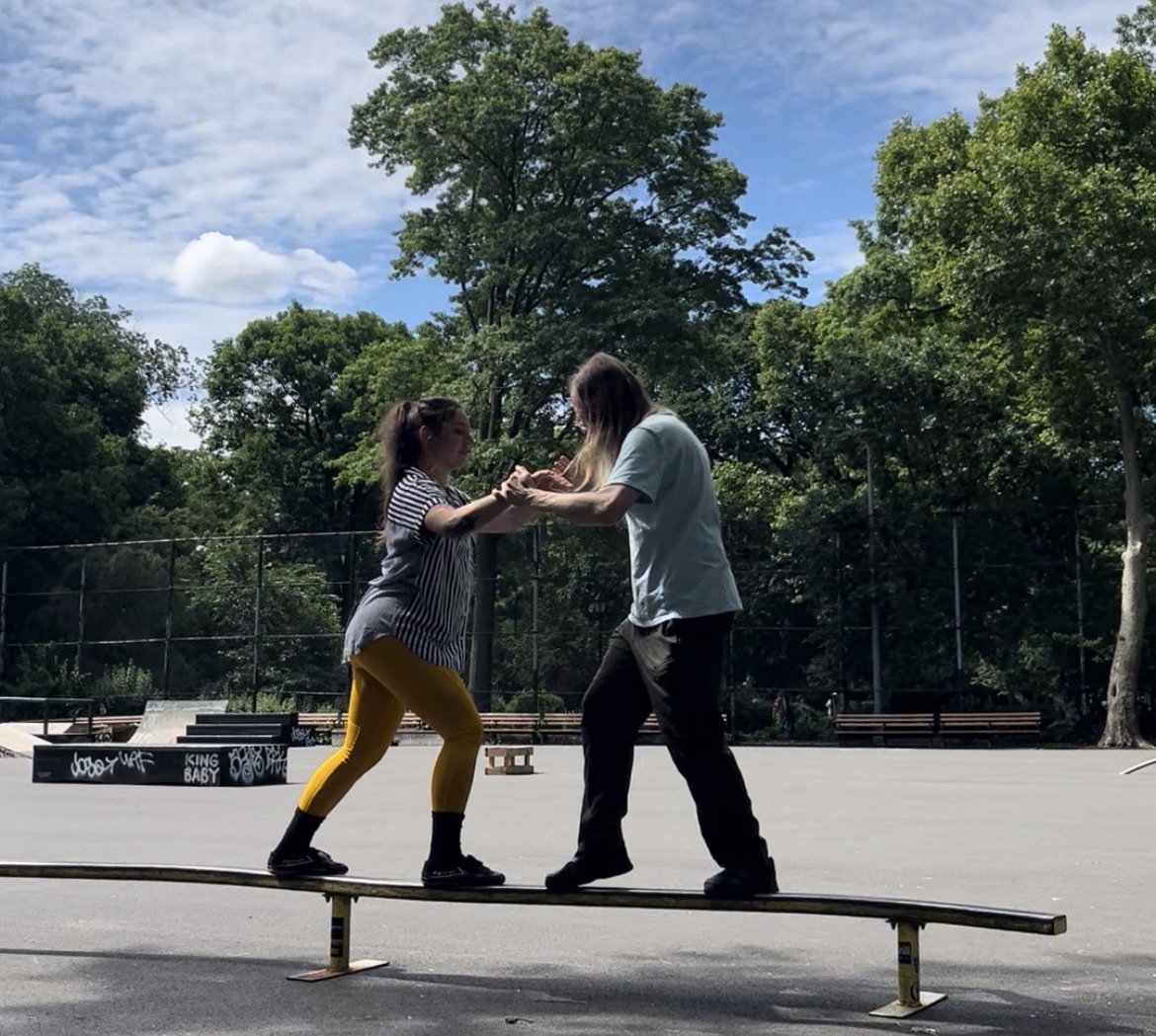
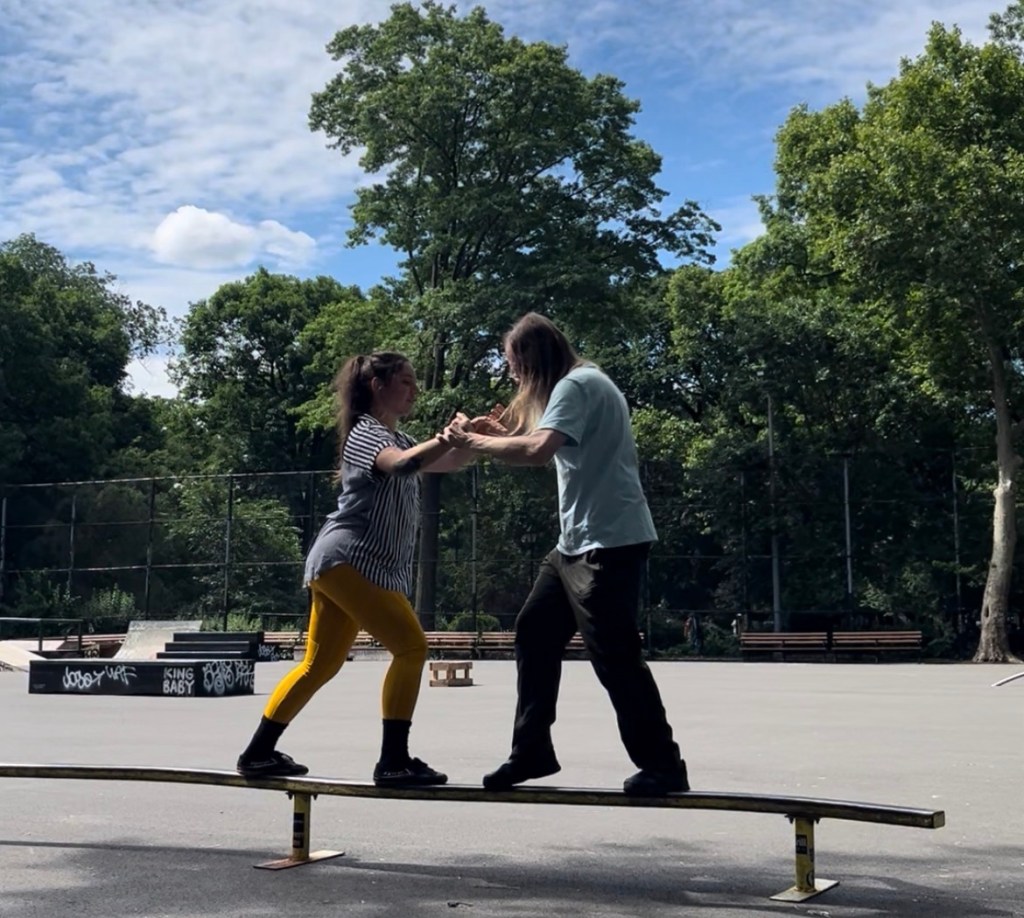
Wednesdays 6PM Tompkins Square Park: Push Hands Now www.pushhandsnow.com Please RSVP for precise location, weather cancellations, etc… FREE, contributions appreciated
Mondays 11-11:30 AM Tai Chi Qi Gong intro on Zoom Continues Please RSVP for Zoom Link $15 or 5 for $60
Next month I plan to confirm the Fall schedule, returning to Saturdays in SoHo.
NEWS: In June I accepted two new Tai Chi Instructor positions- One for Faculty and Staff at Fordham University’s two NYC campuses, and a Corporate wellness program by Team Exos at the new JPMorgan Chase Head Quarters. Since then I have had the privilege to work with several wonderful new students, who have expressed deep gratitude for the time they step away from work and begin this tai chi journey together.
I’ve also been experimenting with my online teaching platform on Skool. So while I haven’t been writing as much on this blog, I’ve been drafting content that you’re welcome to explore; Tai Chi Lab with Ilona Bito. Thank you for your engagement! I hope you are each enjoying your journeys this summer, and look forward to the next time our paths will cross.
… about the VII International Tuishou Competition in Guadalajara, Spain on 11/16/24, and what made it so special.
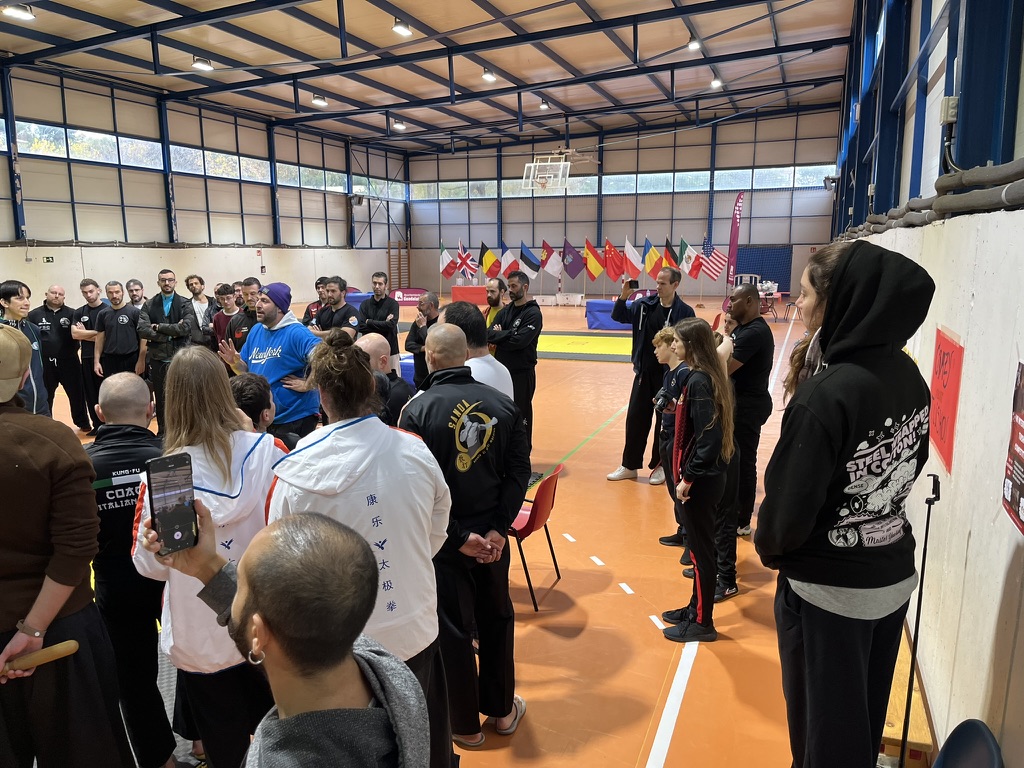
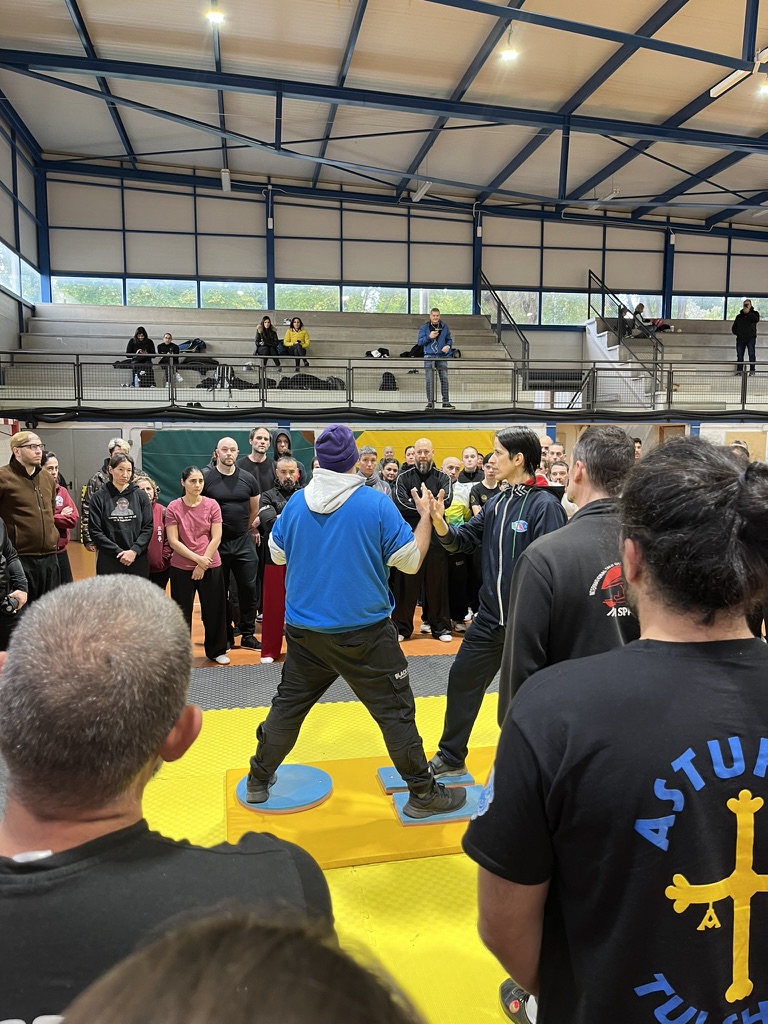
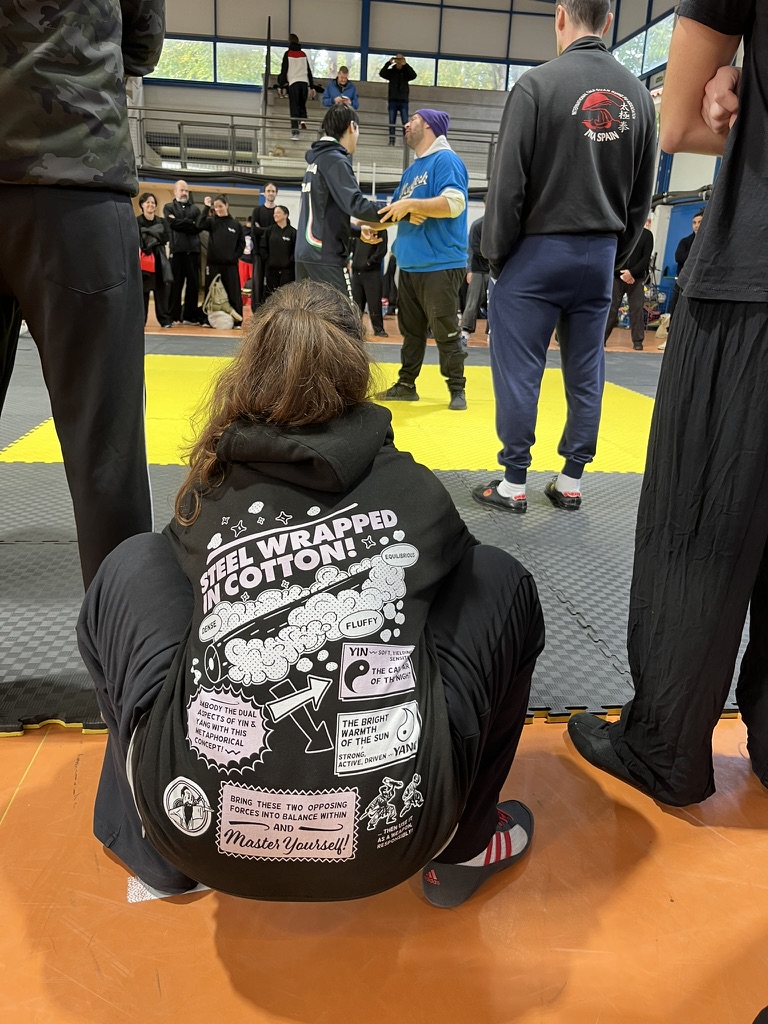
The most obvious distinction: there is ONLY push hands (tuishou) at the International Tuishou Competition. No tai chi forms or weapons demonstrations, not to mention any other style whether internal or external. This creates an environment where martial artists from any style will compete together according to relatively safe rules. I’m used to killing a lot of time at crowded tournaments. Typically a handful of tai chi people occupy one odd ring midst a zoo of other performances and point sparring. This mix makes it harder to focus on the sport we trained for, and leads to scheduling issues. For example, judges or referees have been assigned to events that they have little or no experience with.
I’ve never encountered teams of female players at this level before. I imagine what it would be like to train with 5-10 other women, to travel together and support each other through tournament day. I love my team that consists of my husband and my daughter of course. I also have hopes of recruiting and training a US Team for the World Cup next year.
Scenes from the opening: organizer Naxo de la Encina explains the rules.
Neither have I encountered a youth push hands competition before. There were not a lot of kids, but there were serious girls and boys there with their coaches, playing by the same rules as the adults.
Having so many skilled opponents in my division and either being in a match or being on deck from 9AM-6PM made this my most challenging tournament yet. During the hour break I ate half an egg and half a banana and literally took a nap on the mats.
The day was designed to be at this high level, planned to not waste your time but to keep you in a ready state. I get it, in my bones I can feel this is a tournament for people who love to play tuishou, organized by someone who truly loves to play tuishou. I asked around to others who’ve competed around Europe and Asia if any other events elsewhere compare, and from what I hear, it’s not just the most fun, it really does bring the best players.
King of the Mountain events (both fixed and moving) demanded another level of stamina and focus. Medals are awarded based on the total points scored in the 10-20 minute game (time determined based on the total number of competitors.) I believe this is also part of the Legends of Tuishou annual tournament in Moscow. If you score, you stay in the ring, and if you don’t you go back to the end of the line. When you’re in, each match is against a different person, so focus is even more important as it’s harder to apply any predictive strategy. Every time I got out, I pinpointed the exact moment my mind called out “Has it been ten minutes yet?” or “Is anyone as tired as I am?”
Fixed Step Queen of the Mountain Highlights Reel @taproottaichi
Fixed Step tournaments follow Taiwan rules, with the same platform, and with even clearer judging on fouls in my honest opinion. It seems the format differs a little to give all players more matches, so I was able to play every one in my category. I read the rules, but I don’t speak Spanish and there is not a very clear English translation. I think it’s worth creating the document, since I would want to recreate a very similar tournament in my hometown.
Moving Step rules follow Beijing rules, which I had never encountered before. This was my first time competing in a tournament that allowed foot sweeps and trips. There are a few US tournaments that also include these judo style take-down techniques. I’ve only taken one judo class ever- and I drilled hip throws the entire time. So, I’m glad I accomplished a couple in the ring. I worked with Naxo a couple of times when he was in NYC last spring, which gave me an idea of what to work on, and it definitely gave me a good idea of what it’s like to be swept and thrown and still get up and do tai chi. I’m also more familiar with scoring that favors the player that lands on top when both players fall, however here there is no point in that case.
Finally, there is a meet after the awards have finished. Instead of a banquet dinner or further formalities before everyone packs up and grabs business cards and goes home, what do tuishou players really need? More time to play tuishou. Allowed to shed the armor and drama of competition day, I got to play again with some of my competitors, and with many women and men I wouldn’t have otherwise. It was fun to see several of the guys calling dibs on playing me next. Friendly, relaxed play and skill sharing are always fun, and it always breaks my heart to miss that opportunity when I’ve finally met some other players from out of state.
I think a chance to play again in a celebratory atmosphere is good for both the mind and body to process what it’s just been through, to recover and learn the most. I’m very happy to say I didn’t get injured at all, though I was sore in all the right places, with a neat row of bruises under each arm. I got a scare when someone’s knee landed in my abdomen, mainly because I didn’t think it was an accident, but I was fine. I don’t have a full report on the event, but I know there were a handful of sprained ankles and a dislocated shoulder, nothing too gruesome. Since all events and awards were finished by around 8:30 Saturday, Sunday welcomed everyone back to come together as music played and friends were made. This went on for about two hours, but I think it could have been as good for at least four or five.
The rules explained a game that I’d only seen kids play out of jest and had never given serious consideration. I thought team push hands, two vs. one, would be one of my events, and a very interesting one to watch. The setup is from the same position with three people arranged in a triangle. The one is connected to the two on either side, so the two can actually coordinate attacks and defenses together. I got to play this once or twice at the Sunday meet, and share one of my coach’s favorite restricted step variations. With more time, I would have asked Naxo’s students about more of the games and variations I find so appetizing.
In my experience, the playful heart of this game is rarely seen so clearly. Innovative experimentation, inviting openness to new information, leads the growing edges of this art.
When Naxo de la Encina told us about this tournament he had organized in his hometown, he was also encouraging us to do the same. He acts like a Tuishou missionary teaching and promoting all over the world, sharing his passion. I am so grateful that he has created this experience for a whole generation of players, and for his inspiration. It wasn’t easy, and it was so worth it.
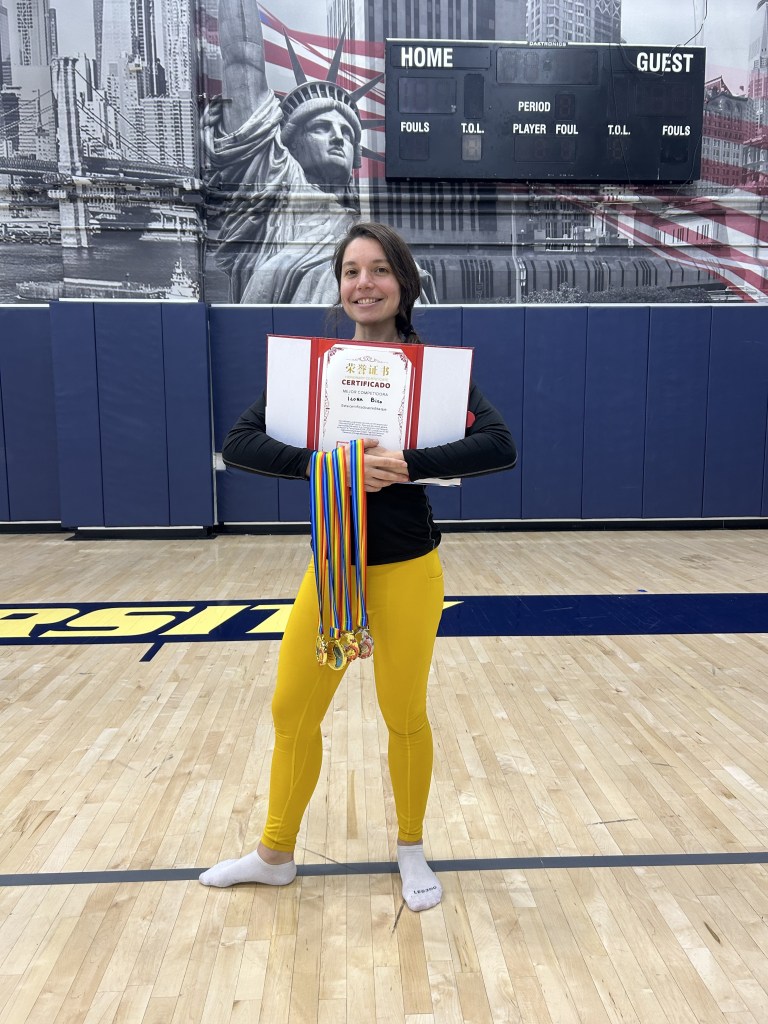
Back home at Pace University, NYC
Just to top it off, I have never seen such beautiful medals or certificates. Rainbows and glitter, really? There was even a cake, just to share.
There were so many amazing competitors, and my videos here only capture some personal highlights and points to remember. In addition to my 3 gold medals and one silver, I was awarded the highest honor at the close of the awards ceremony:
One year ago I was maxing out my training in preparation for the biggest fight of my career. The event itself was delightfully worth the preparation that it took, but it was the training season that set the stage and that raised the bar for me. I made a few attempts at journaling on those long days- logging hours in contact with other bodies, notes and short video studies on my training partners, alternating workouts and runs, making weight, insights from my meditations… It’s a hard article to write because I’d rather be logging the hours right now than sitting at my computer- so I’ll compromise and stand.
I feel that I owe it to my students to actively engage in research and development in the field. In other words- to be “still undefeated” in my division, I have to seek out my challengers. I am grateful to be teaching more, and to have work that I can count into my training time now. Four days a week working with performing arts undergraduates is my favorite addition, since they are naturally competitive from the start. The curriculum design has also been an opportunity to digest and organize the wealth of knowledge I collected during my journey to the World Champion title. My perinatal fitness clients also give me an opportunity for training stability and mobility from the core. This training season also looks a little different due to time and funding constraints and if you’re a parent of small children you might get the picture- I won’t let my daughter near competitive push hands for a few more years until she has more self control. I have to be ready to make the most of stolen time, and when I get the chance to train I look back on my peak training experiences and draw on them.
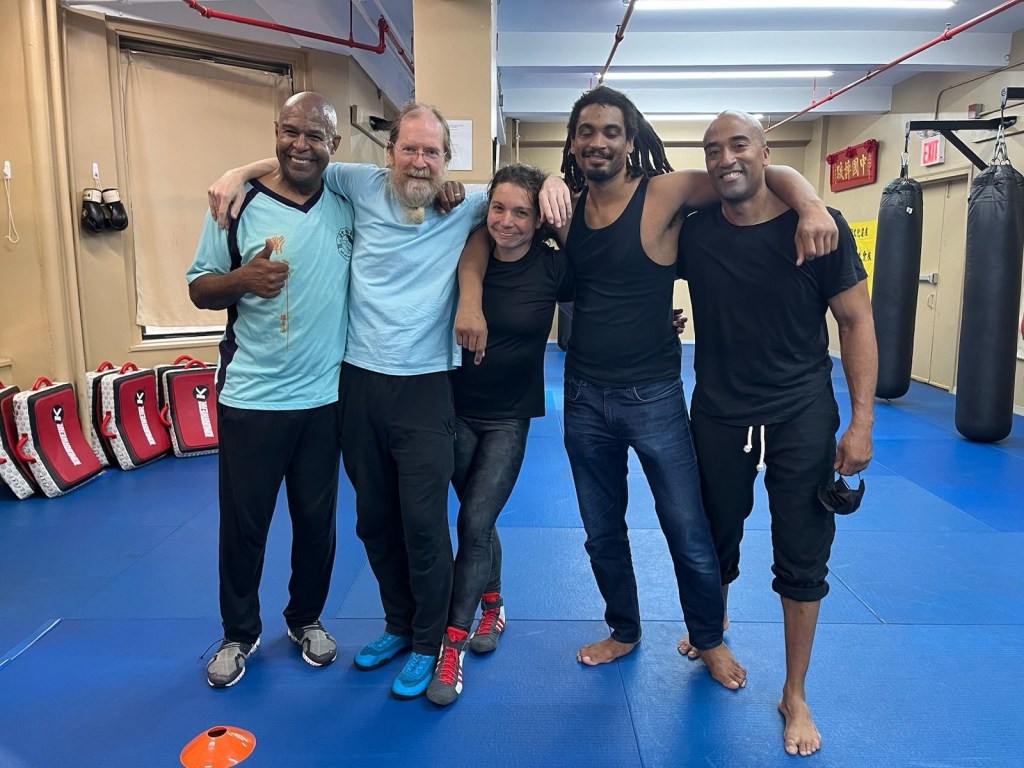
Left to Right: Jan Childress, James McConnell, Ilona Bito, Michael Weston, Indie Randall 10/23/2023
The one that comes to me most often- where the movie training montage in my mind begins- was a solo interval sprint on the trail where my family hikes every week. Two minutes uphill, one minute recovery, for about 40 minutes to the top. These are approximately the intervals of rounds played, building the power and stamina required for moving step push hands. The recovery walk in the woods became a moment to spontaneously process physically- I’d mark hand drills with tree branches, practice animal walking balancing on logs, enter a yoga posture and find a headstand. This year, I’ve been doing the uphill with 40+ pounds on my back, while pretending to be a fairy witch with my daughter.
The ideal training season would allocate four hours to push hands a day. This number comes from my coach’s coach, insisting that any less than that, and “you can only be a tourist in this lifetime.” At least two hours of that time would be at the tournament level- quick draw, on the mats, with the most experienced training partners. This would be in addition to the cross training required to enter competition in peak physical condition.
The movie montage would cut from the trail to the dojo mat, to the skate park asphalt- me being thrown by guys twice my size, then me holding my ground, then the breakdown of techniques, and my surprise when they worked. Some of these were done virtually from across the country too. My coach and I reflected and talked about training and competition strategy daily. This year, I’m getting more hours of partner work in the Aikido dojo, and find the ukemi practice essential to be prepared for moving step on the mats. Now that I think of it though, I haven’t even worn my wrestling shoes once since last October. Other scenes include the gym and my in home zoom studio- holding the horse stance, mastering kettlebell basics, Sinew Meridian Qi Gong, kickboxing, sparring and heavy bag training. I worked with a personal trainer for the last couple of months as I dropped fifteen pounds. I’m dropping weight again this year- cutting any unnecessary calories, running, and staying hydrated all contribute to my sense of mental focus and concentration on my goal.
Tai Chi players sometimes call each other “strong” as an insult, implying a reliance on brute force over technique. If I didn’t train for strength and endurance I would undermine push hands as an athletic sport. Athletes do not just put their faith in skill and trust in technique, they develop it with practice, sweat, and the tears that come when your mental stamina has reached a new edge. I also log the hours training for softness. My coach often remarks how I came out of the pandemic, pregnancy, and childbirth a more skilled player. During this time I also was not able to hit the mats with opponents, and instead what I practiced was sensitivity. We call it “Hemophilia,” “4 ounces,” or “Feathertouch.” You learn to get any weight off of you and direct that weight off balance. Played properly, differences in size and strength won’t make much difference, and training can continue even if injuries need time to heal or if there isn’t time to warm up.
I want to compete again. For years I had a shirt from my alma matter Sarah Lawrence College that said on the back: STILL UNDEFEATED. On the front it said football, and of course we never had a football team, which made a hilarious joke. Rather than become a joke, I am committed to putting my practice to the test. Since Taiwan happens only every other year I’m throwing my hat in to a couple of new international venues. It turns out there is a yawning gap between training as if I had a tournament coming up and training because I am going to compete in a matter of weeks. I wonder if one day being registered and have my competitor number lined up will no longer be necessary, but for now it motivates me. This year I’ve had to be even more self directed, testing what I learned last year.
Last year I ran an official Make A Champ campaign to raise funds for travel. While I won’t this year, I will still be grateful for contributions and sponsorship of all sizes, check out the 15 Goals page for links to contribute. It’s also really motivating to hear from my readers. Thank you!
From my heart,
Ilona
PS: On OCT 5, 2024 I won double golds in Boston: WFMAF World Open Martial Arts Championship.
In this month’s article, I consider the lineage and family of 15 Goals Tai Chi, and how studying different styles of Tai Chi can be a lot like visiting your in-laws...
Emergent Style in Tai Chi. Diverse and Divergent Form within the Yang Lineage.
15 Goals Tai Chi is in the Yang style, derived from the Yang family of Tai Chi Chuan Masters. Perhaps “style” is a somewhat backward way to describe the significance of lineage. Doesn’t style imply a superficial doffing, a fashion of the time? In tai chi, the essential movements of grasping the sparrow’s tail for instance, the foundational stances, indeed the same philosophical underpinnings, are found across families- Wu, Chen, Yang, Sun… Insight into what most families see as most important, versus niche specialties and identifying markers of where we learned our forms, reveals the root, the deeper structures of tai chi.
In conventional, familial terms, or amongst our personal immediate and extended families by relation- it’s been proven that there is more characteristic diversity between family members than across families, and this diverse internal structure becomes another commonality all families share. We know that apples often do roll quite far from the tree. They are sold in foreign markets, processed, etc.. And seeds that lie close in the shade of the mother tree will have a proper upbringing to make them hardy, but they will have to wait for their turn to flourish.
Particularly in Chen Man Cheng’s tai chi family, a branch of the Yang family tree, his students in New York City went on to focus on different aspects of the form and teach in dramatically different ways. Not to mention the myriad practitioners who only studied with him a handful of times but nevertheless count themselves inside that circle. William CC Chen is one of Cheng Man-ching’s last living disciples still teaching today. He has the passion for innovation of a brilliant scientist. Divergence sheds light on the unique niche, adaptations, and perspective of an emergent style.
Like visiting your in-laws, stepping out of your own immediate family gives you perspective on your own group’s values and assumptions, expectations and rituals. For example while visiting a new Aikido school after three years in only my home dojo, I make an effort to adapt to several mannerisms, and this makes me stick out right away- the most noticeable differences are bowing frequency and whether we change partners during class. In my own mind, once we get into the nuance of technique, there is only the movement between partners and metaphor left- circles, music, magnets, waves… Of course depending on a subjective perspective, there may be a distinguishable prevalence of certain ranges, angles, and acceleration patterns, in one school versus another, giving consistency to the student’s experience. Such discernment may give an observer the license to say I must be coming from a different style. The story that comes to mind is of O Sensai’s student asking to see a new technique, complaining of doing the same thing over and over for hours of practice. Ueshiba’s wisdom, “You fools, I have shown a different technique every time,” explains all at once that the Aikidoka’s training requires a keen observation of subtle but significant differences, and that learning may be limited by categorically defining where one technique begins and another ends.
Every codified art becomes a language in its way. The number of spoken languages existing in the world varies greatly depending how you count them, whether you are a lumper or a splitter, counting branches, twigs, or individual leaves on the family tree. Learning a martial arts system feels similar to learning a language, and probably more so if you never learned Japanese and all the techniques have Japanese names, for example. The journey cannot be completed alone. You make progress through consistent effort from piecing together a few vocabulary lists, then phrases, all the way up to the mastery of fluency, towards creative personal expression, including poetic license. Keep lumping tai chi styles and you would next lump it in with kung fu or all Chinese martial arts, then judo and aikido, but you could keep going to the level of all boxing and grappling styles. Learning the existing vocabulary of distinctive systems, we learn to recognize patterns, which in turn reveals more individual differences, stand outs, and innovators.
In Tai Chi Push Hands it seems common within a school or a group of players for each person to play completely differently and even to give advice that contradicts one another. Some may be off track, closed to new ideas, completely following their own logic in order to test it against their teacher’s. It’s more often the case however, that they have sincerely interpreted the teacher’s guidelines to integrate into their own understanding, yielding an array of possible outcomes. Observing these kinds of patterns seems to reveal a more fitting use of the word style. Style is not given to you with your uniform or your first certificate- which signify the family lineage you represent. Style must be developed as an expression of your understanding. In competitive push hands, fighting style may be influenced very strongly by differences in physicality and ability since size, strength, speed, and flexibility all determine what strategy is most advantageous against most opponents. Perhaps players diverge so much because at the same time you are learning from someone, you are also trying to win against them. While studying a teacher’s approach, a student is also developing a method to avoid, withstand, and overcome the predominant style. And an element of surprise helps to wake each other up from following in lock step with our peers.
As a team, consisting of me and my partner and coach James McConnell, we share a knowledge of Grandmaster Chen’s studied body mechanics, which we continue to test and experiment with. We consult coaches for training advice and practical insight. Our coaches include Max Chen, William CC Chen’s son, who has built a San Shou career out of his fighting victories. Especially valuable has been the harvesting of tournament experience from Jan Childress, and his son, Jan Lucanus, who have both won multiple World Championships in tai chi push hands. We can see that we have developed a push hands style that diverges from the predominant style seen in Chinese tournaments. We can identify this from the angle of the pelvis, and the tendency to double weight. Our style of engagement is consistent with our practice and our teaching of 15 Goals Tai Chi, and vice versa.
Of course we need the “style” categories for formal competition, just as we need limiting rules for striking and grappling sports. Is there any such thing as pure sport, even in the Olympics? Sporting events of all kinds serve a cultural identifiers. The categories in Tai Chi tournaments play an important role as cultural heritage markers memorializing the history of tai chi. As an analogy, consider today’s American Indian PowWow dancers at once representing and modernizing the Smoke Dance which was once performed before and after battles, but now is a virtuosic performance for today’s audiences, done by both men and women in brightly colored and sparkling costumes. At the competition the dance judges need to be experts on the specific criteria for each category. Comparing tai chi to a dance has its place. The importance of the different forms shared by the overarching tai chi family around the world comes down to choreography and its creators. Reverence for the cultural lineage from the Yang family traditions of China, makes the assignment of our form to a “style” meaningful in context of who developed this art and kept it alive in a changing world. Lineage, or family, are more descriptive terms in contemporary contexts.
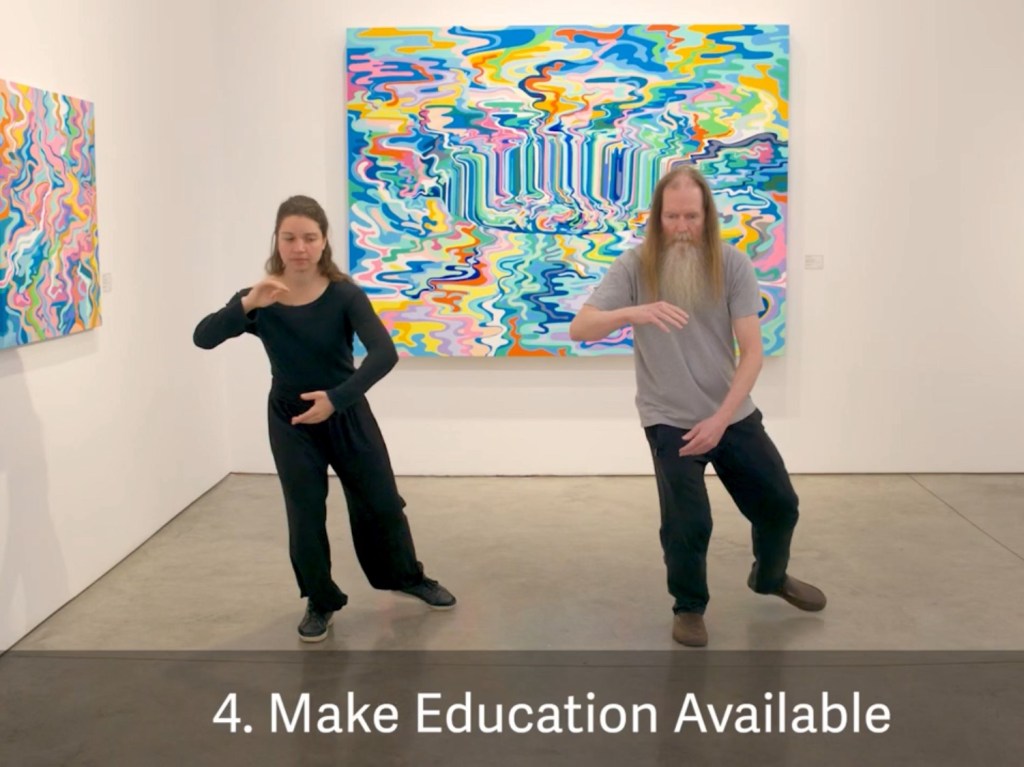
15 Goals Tai Chi calls attention to a unity of values across a range of experiences as diverse as our world. The instructions for solo form practice are guidelines for using the wisdom of the movement of water to move past obstacles and shed unnecessary burdens, to make collective progress on the Sustainable Development Goals. It is for everyone regardless of Tai Chi background, affiliation, or ability.
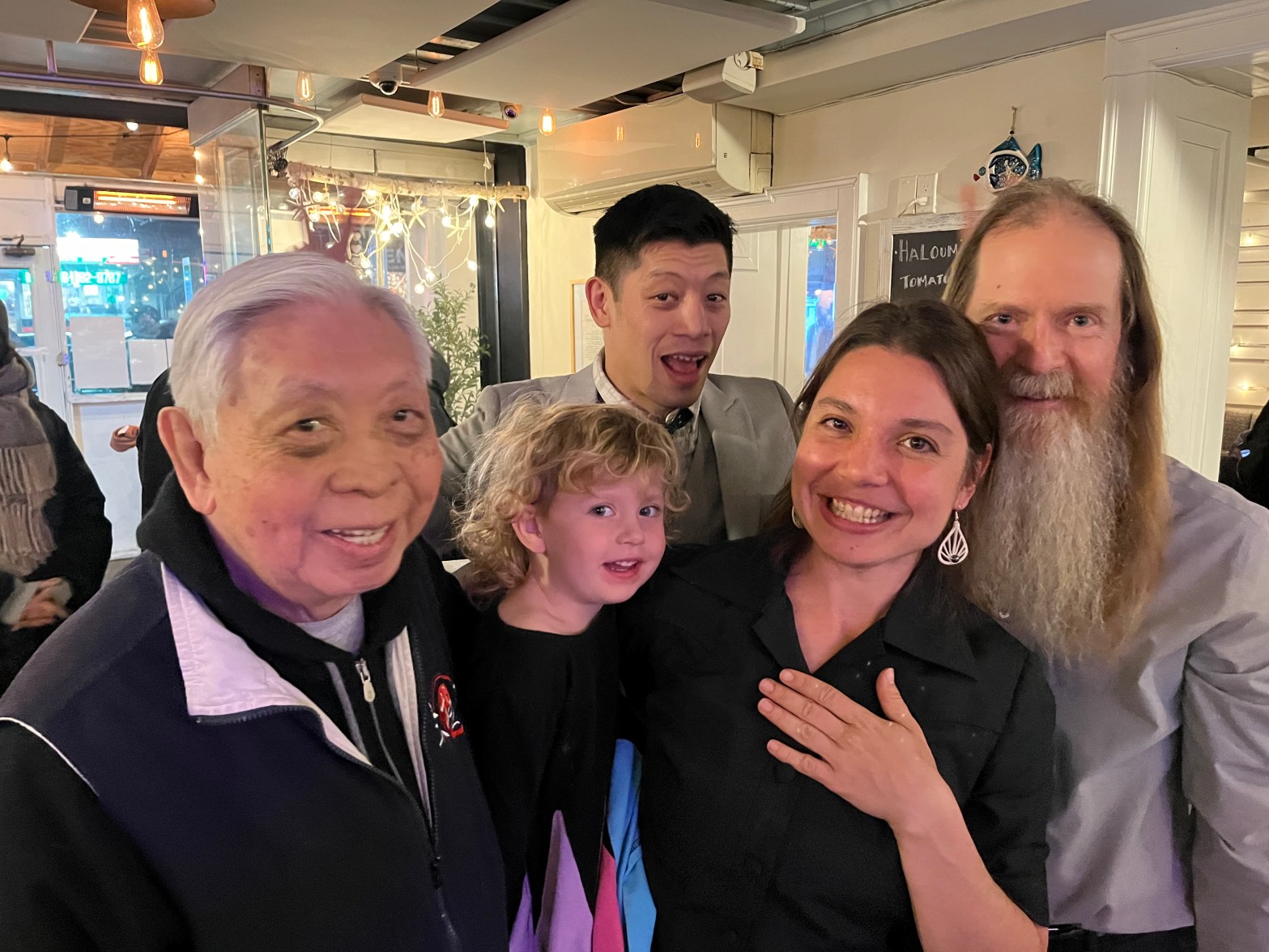
Four Generations of Tai Chi practitioners in NYC 2024 (left to right): GM William CC Chen , Bear Bito McConnell, Maximillion Chen, Ilona Bito, and James McConnell.
“Standing alone and unchanging, one can observe every mystery. Present at every moment and ceaselessly continuing, this is the gateway to indescribable marvels.“
–TAO TEH CHING
Solo tai chi practice is standing meditation.
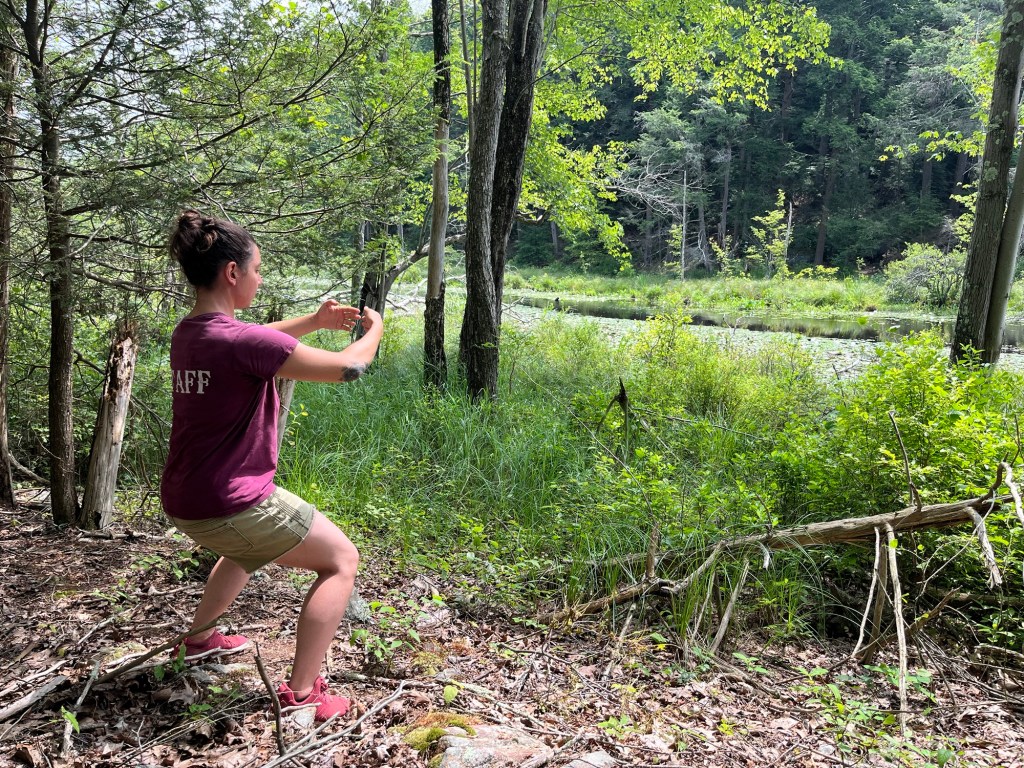
In Holding, or Embracing, the Tree, stand in the “wu chi,” position- translating literally to “without separation,” referring to the moment before distinction, a meditative moment of both emptiness and unity. The weight is evenly distributed between both legs. Feet are shoulder width apart and the second toes are parallel to each other. Ankles, knees and hips are folded softly, aligned so that the knees release forward over the toes but not past them.
The arms form a circle in front of your sternum. You may look into the palms of your hands as you extend all ten fingers towards each other, with about an inch between the longest fingers. As if they are trying to wrap around a tree trunk, this extension comes from the expansion of the upper back, scapulae spreading down and out like wings.
There are stories of practitioners from ancient China attempting to pull a tree up out of the ground with a thrust through the legs, tasked to prove their worthiness to study with a great master. Of course, on accomplishing the feat, they have already mastered tai chi and are no longer fit to be students.
Enduring this practice for long stands can lead to great changes, as the body learns where it is exerting unnecessary effort. Start with 5 minutes and increase gradually up to 45 minutes. Concentrate on diaphragmatic, or belly breathing. The legs may shake, which will encourage the big muscles and habitual patterns to let go, giving way to more to more refined, intrinsic organization.
With a partner, your task is to hold your ground by yielding and directing the force down through your feet into the ground, while being pushed or pulled. Your partner will first push into your forearms. You should not become stiff, or collapse with their pushing. Your partner might let go suddenly, which will tell if you are resisting, leaning into the force, rather than absorbing the force. If the structure is collapsing, and the circle is shrinking, your partner can press inwards on both elbows slightly. Expand across the collarbones and out. Your partner may also try to pull you from this front position. Keep sitting into the fold of the hip joints.
A good partner will also be rooting as they push and pull, sending the force from the ground, through their center, into your center in a way that helps you to feel your structure. The person pushing is also developing their structure and ability to sense yours, and if their arms are doing most of the work this is less accessible. They should be able to start with a clear direction but very little pressure, and gradually pour on more pressure. Then they can try fluctuating unexpectedly, even move away completely.
When they push from the side, with one hand on the shoulder and the other on the hip, you should feel the diagonal axis down to the opposite foot very clearly. Last, they may test you from behind, by placing two fists right behind your navel and applying just enough pressure to unbalance you.
Rooting exercises like standing meditation and being pushed by a partner can be practiced in any posture. In fact, they should be practiced in every posture. Try doing the form and pausing for one minute in each posture. To further understand each of the other postures, which are no longer symmetrical, your partner tests you- “Don’t let me push you, don’t let me pull you,” and the person pushing will search for openings, or weak spots, through diagonal and curved vectors. There is a systematic method to this called the eight gates, which is an excellent illustration of the geometry of push hands, or tui shou. With experience, players build an understanding of these gates that is inherent in the game.
Standing still, balanced, relaxed and ready for movement in any direction, is essential at every stage of learning tai chi, and should not be forgotten regardless of advancement to new techniques.
…
This month’s article is a practical homework assignment, mostly instructional. I recommend tree standing either to begin your practice or begin your day. On a personal note, I learned this practice from my teacher, Daria Faïn , about ten years ago, and it is still the first root of my martial arts practice. A 45 minute stand was the test for my Iron Shirt Instructor certificate. This was my morning practice in my hotel room in Taiwan on the day of my World Championship. In addition to tree standing, Daria has taught me several meditations both standing and seated which made stillness core to my training regimen. Her next workshop is coming up this Saturday July 13th, at the same location as Taproot’s Sunday session in Soho, NYC. Please find more information here!
A reflection on the Hall of Fame Banquet at AWMAI 2024 Conference: Teaching the Teacher in Columbus, Ohio.
It was an honor just to be in the room at the Association of Women Martial Arts Instructors Hall of Fame Banquet. The dinner punctuated a very full weekend of professional development workshops. The awards ceremony inducting this year’s 30, 40, 50, and 60 year career honorees activated a sense of meaning, gratitude, and respect for the work we do. Amelia conducted the room so gracefully, a true Master of Ceremony, pulling on my heartstrings to lead me down the long and winding path to mastery. Honoring the careers of women martial arts instructors, complete with triumphs and challenges, injuries and healing, the Hall of Fame reminded me that I am really only at the beginning of my journey. To each person who in their way encouraged me to stay the course and be patient, thank you.
As a first time attendee reaching the halfway point in the weekend, I was only just getting used to the general temperature of the water as I splashed around, checking my diving mask and snorkel, meanwhile rare, exquisite, giant creatures were floating past the whole time! Who knew I had been rubbing elbows with Olympians!
Meeting Sunny Graff and Helen Yee for the first time was a highlight for me- here are women who won their first championships in the year I was born. They could relate to my experience having mostly trained with men. In no time we were troubleshooting how to get our students to meditate. I appreciated that here are masters who after all of their accomplishments clearly love to teach and continue to dedicate themselves to start over again and again. Kore Grate’s true love for her students, as young as four, made a very strong imprint is in my mind with a smile and a sparkle, feeding my fire to find focus in the chaos and creativity of early learning.
I heard a few seasoned members called this annual gathering a Nirvana, or a safe haven, free of judgement and competition. Personally, heaven for me would be a gathering where hundreds of women from different martial disciplines will get to play push hands together. Last week was World Tai Chi Day. At the New York City event, I’d say that roughly, out of about 70 people playing push hands, I saw four other women participating. Two were there for the first time, and quite surprised by this gap in representation, feeling a little disappointed and confused, and relieved that we found each other. I just share this to reflect that, while women in martial arts now have more role models than we might have 40 years ago, there is still need for AWMAI, still work to be done.
I wasn’t sure I was going to attend the Hall of Fame Ceremony on Saturday Night, but I am so glad that I did, and I realized that night that my first conference experience would have been incomplete without it. Sure, I could read the illustrious bios of the honorees in the conference book– a good substitute for those who could not be there in person. This was my first year joining AWMAI, and I didn’t think I had a personal connection with the honorees, or that the banquet was really for me, but I was wrong. Of course, it is for the honorees, but in a larger sense, it is for them to inspire and uplift other women martial arts instructors, so everyone in the room with their different, but overlapping experiences, played an important role that evening.
The medicine you want is not always the medicine you need. While what I most wanted was to practice with other martial artists like myself, what I most needed was to step back and gain perspective from those who have led the way. I was so surprised about how fired up I got about what I expected to be the ‘boring’ parts, like a workshop on business models. Hearing honestly from Wasentha Young, Nancy Lanoue, and the active participants in the discussion made me feel excited about growth, adaptation, and mutual support.
This ceremony as well as the wisdom shared in workshops served to deepen my gratitude to my own teachers back home, both women and men who have not only given me the opportunity to learn and train for which I am thankful everyday, but have also had to don many hats and navigate the stormy seas to lead schools in NYC.
Other highlights included the demos- which were unlike any I’ve seen at tournaments- sincere presentations carrying a message, from Jay Spiro’s call for ceasefire, to Lisa Santi’s heartwarming celebration of three generations’ shared practice. I returned home feeling prepared with a few new games to celebrate skill, safety, and the art of play, and reconnected to the joy and creativity at the center of my teaching. I want to add to my gratitude that my participation this year was made possible by the organization’s scholarship fund, as well as my family’s support with childcare responsibilities. My time to socialize was limited, but I look forward to being in the network and meeting again soon.
To celebrate, please enjoy, share, and support this new project, for the benefit of everyone and the future of tai chi. Right now all contributions to Taproot Tai Chi go towards furthering the mission of 15 Goals Tai Chi.





 Push Hands Now