In this month’s article, I consider the lineage and family of 15 Goals Tai Chi, and how studying different styles of Tai Chi can be a lot like visiting your in-laws...
Emergent Style in Tai Chi. Diverse and Divergent Form within the Yang Lineage.
15 Goals Tai Chi is in the Yang style, derived from the Yang family of Tai Chi Chuan Masters. Perhaps “style” is a somewhat backward way to describe the significance of lineage. Doesn’t style imply a superficial doffing, a fashion of the time? In tai chi, the essential movements of grasping the sparrow’s tail for instance, the foundational stances, indeed the same philosophical underpinnings, are found across families- Wu, Chen, Yang, Sun… Insight into what most families see as most important, versus niche specialties and identifying markers of where we learned our forms, reveals the root, the deeper structures of tai chi.
In conventional, familial terms, or amongst our personal immediate and extended families by relation- it’s been proven that there is more characteristic diversity between family members than across families, and this diverse internal structure becomes another commonality all families share. We know that apples often do roll quite far from the tree. They are sold in foreign markets, processed, etc.. And seeds that lie close in the shade of the mother tree will have a proper upbringing to make them hardy, but they will have to wait for their turn to flourish.
Particularly in Chen Man Cheng’s tai chi family, a branch of the Yang family tree, his students in New York City went on to focus on different aspects of the form and teach in dramatically different ways. Not to mention the myriad practitioners who only studied with him a handful of times but nevertheless count themselves inside that circle. William CC Chen is one of Cheng Man-ching’s last living disciples still teaching today. He has the passion for innovation of a brilliant scientist. Divergence sheds light on the unique niche, adaptations, and perspective of an emergent style.
Like visiting your in-laws, stepping out of your own immediate family gives you perspective on your own group’s values and assumptions, expectations and rituals. For example while visiting a new Aikido school after three years in only my home dojo, I make an effort to adapt to several mannerisms, and this makes me stick out right away- the most noticeable differences are bowing frequency and whether we change partners during class. In my own mind, once we get into the nuance of technique, there is only the movement between partners and metaphor left- circles, music, magnets, waves… Of course depending on a subjective perspective, there may be a distinguishable prevalence of certain ranges, angles, and acceleration patterns, in one school versus another, giving consistency to the student’s experience. Such discernment may give an observer the license to say I must be coming from a different style. The story that comes to mind is of O Sensai’s student asking to see a new technique, complaining of doing the same thing over and over for hours of practice. Ueshiba’s wisdom, “You fools, I have shown a different technique every time,” explains all at once that the Aikidoka’s training requires a keen observation of subtle but significant differences, and that learning may be limited by categorically defining where one technique begins and another ends.
Every codified art becomes a language in its way. The number of spoken languages existing in the world varies greatly depending how you count them, whether you are a lumper or a splitter, counting branches, twigs, or individual leaves on the family tree. Learning a martial arts system feels similar to learning a language, and probably more so if you never learned Japanese and all the techniques have Japanese names, for example. The journey cannot be completed alone. You make progress through consistent effort from piecing together a few vocabulary lists, then phrases, all the way up to the mastery of fluency, towards creative personal expression, including poetic license. Keep lumping tai chi styles and you would next lump it in with kung fu or all Chinese martial arts, then judo and aikido, but you could keep going to the level of all boxing and grappling styles. Learning the existing vocabulary of distinctive systems, we learn to recognize patterns, which in turn reveals more individual differences, stand outs, and innovators.
In Tai Chi Push Hands it seems common within a school or a group of players for each person to play completely differently and even to give advice that contradicts one another. Some may be off track, closed to new ideas, completely following their own logic in order to test it against their teacher’s. It’s more often the case however, that they have sincerely interpreted the teacher’s guidelines to integrate into their own understanding, yielding an array of possible outcomes. Observing these kinds of patterns seems to reveal a more fitting use of the word style. Style is not given to you with your uniform or your first certificate- which signify the family lineage you represent. Style must be developed as an expression of your understanding. In competitive push hands, fighting style may be influenced very strongly by differences in physicality and ability since size, strength, speed, and flexibility all determine what strategy is most advantageous against most opponents. Perhaps players diverge so much because at the same time you are learning from someone, you are also trying to win against them. While studying a teacher’s approach, a student is also developing a method to avoid, withstand, and overcome the predominant style. And an element of surprise helps to wake each other up from following in lock step with our peers.
As a team, consisting of me and my partner and coach James McConnell, we share a knowledge of Grandmaster Chen’s studied body mechanics, which we continue to test and experiment with. We consult coaches for training advice and practical insight. Our coaches include Max Chen, William CC Chen’s son, who has built a San Shou career out of his fighting victories. Especially valuable has been the harvesting of tournament experience from Jan Childress, and his son, Jan Lucanus, who have both won multiple World Championships in tai chi push hands. We can see that we have developed a push hands style that diverges from the predominant style seen in Chinese tournaments. We can identify this from the angle of the pelvis, and the tendency to double weight. Our style of engagement is consistent with our practice and our teaching of 15 Goals Tai Chi, and vice versa.
Of course we need the “style” categories for formal competition, just as we need limiting rules for striking and grappling sports. Is there any such thing as pure sport, even in the Olympics? Sporting events of all kinds serve a cultural identifiers. The categories in Tai Chi tournaments play an important role as cultural heritage markers memorializing the history of tai chi. As an analogy, consider today’s American Indian PowWow dancers at once representing and modernizing the Smoke Dance which was once performed before and after battles, but now is a virtuosic performance for today’s audiences, done by both men and women in brightly colored and sparkling costumes. At the competition the dance judges need to be experts on the specific criteria for each category. Comparing tai chi to a dance has its place. The importance of the different forms shared by the overarching tai chi family around the world comes down to choreography and its creators. Reverence for the cultural lineage from the Yang family traditions of China, makes the assignment of our form to a “style” meaningful in context of who developed this art and kept it alive in a changing world. Lineage, or family, are more descriptive terms in contemporary contexts.
15 Goals Tai Chi calls attention to a unity of values across a range of experiences as diverse as our world. The instructions for solo form practice are guidelines for using the wisdom of the movement of water to move past obstacles and shed unnecessary burdens, to make collective progress on the Sustainable Development Goals. It is for everyone regardless of Tai Chi background, affiliation, or ability.
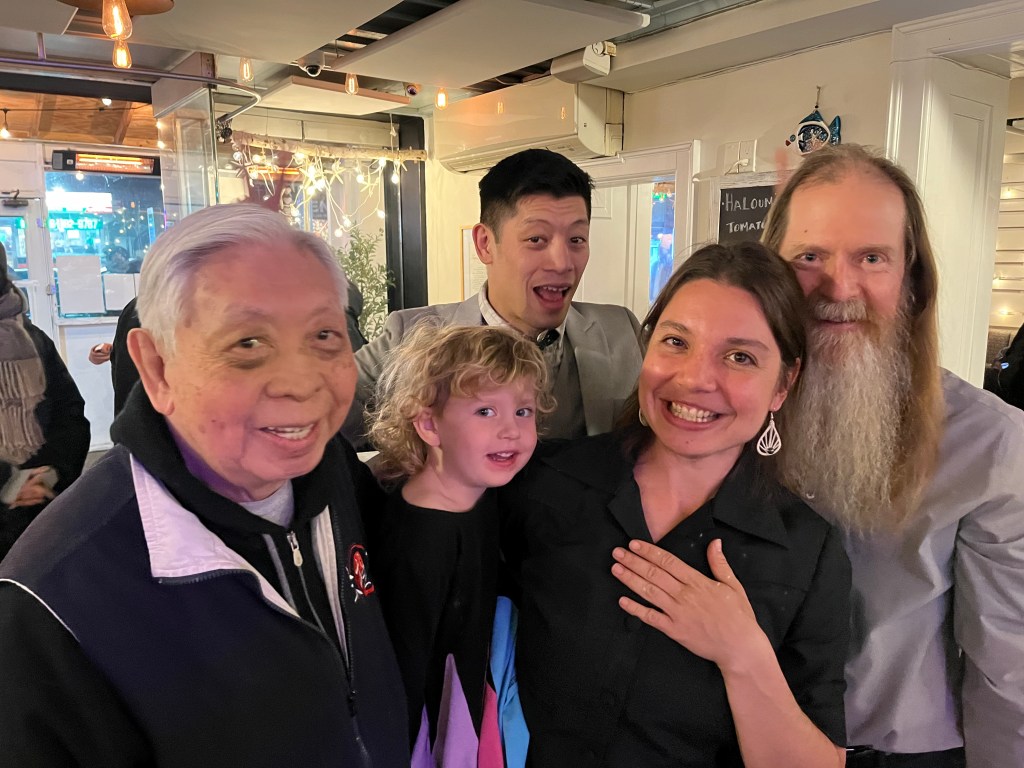
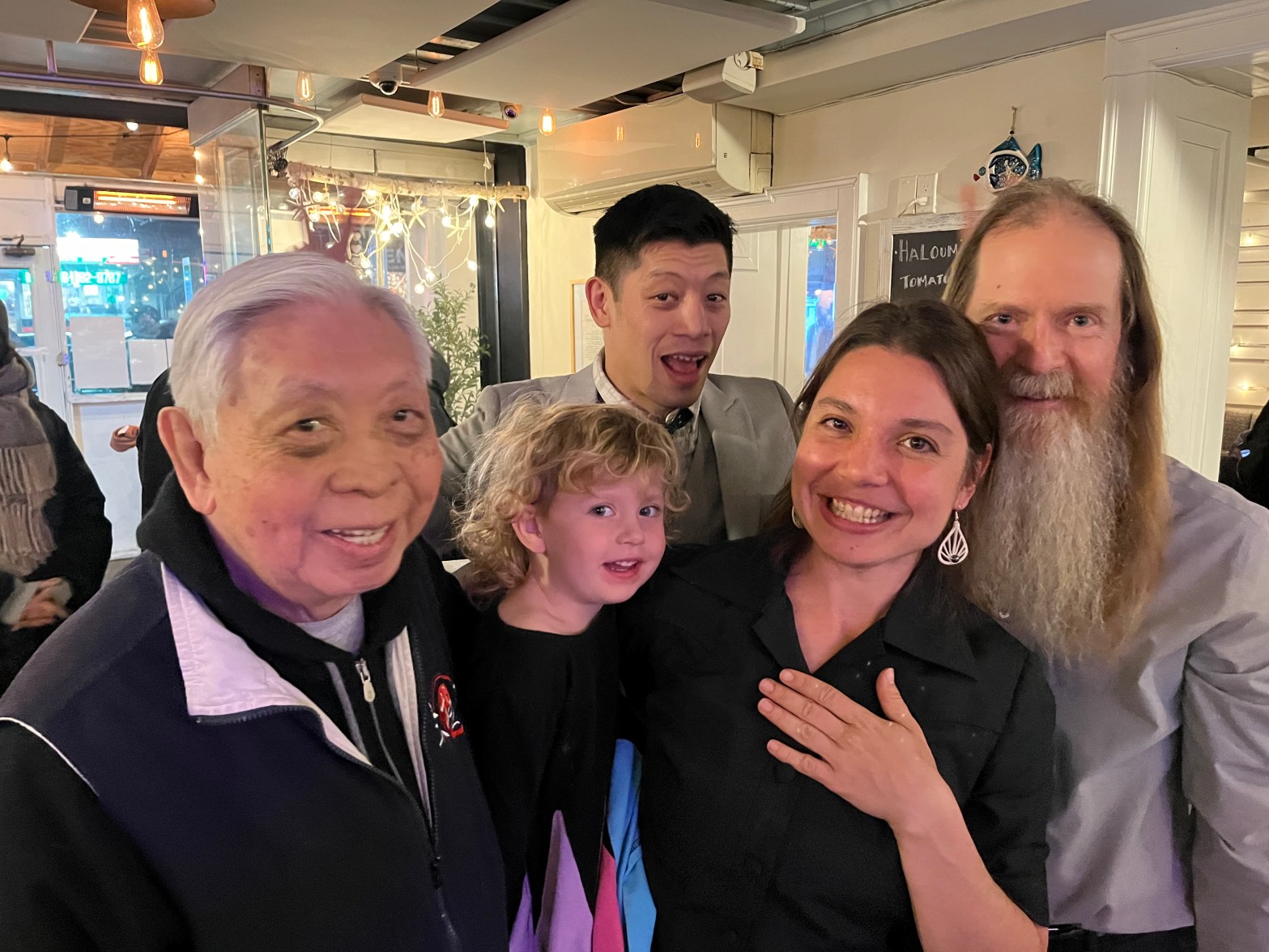
GM William CC Chen , Bear Bito McConnell, Maximillion Chen, Ilona Bito, and James McConnell.
 Push Hands Now