“Standing alone and unchanging, one can observe every mystery.
Present at every moment and ceaselessly continuing,
this is the gateway to indescribable marvels.“
–TAO TEH CHING
Solo tai chi practice is standing meditation.
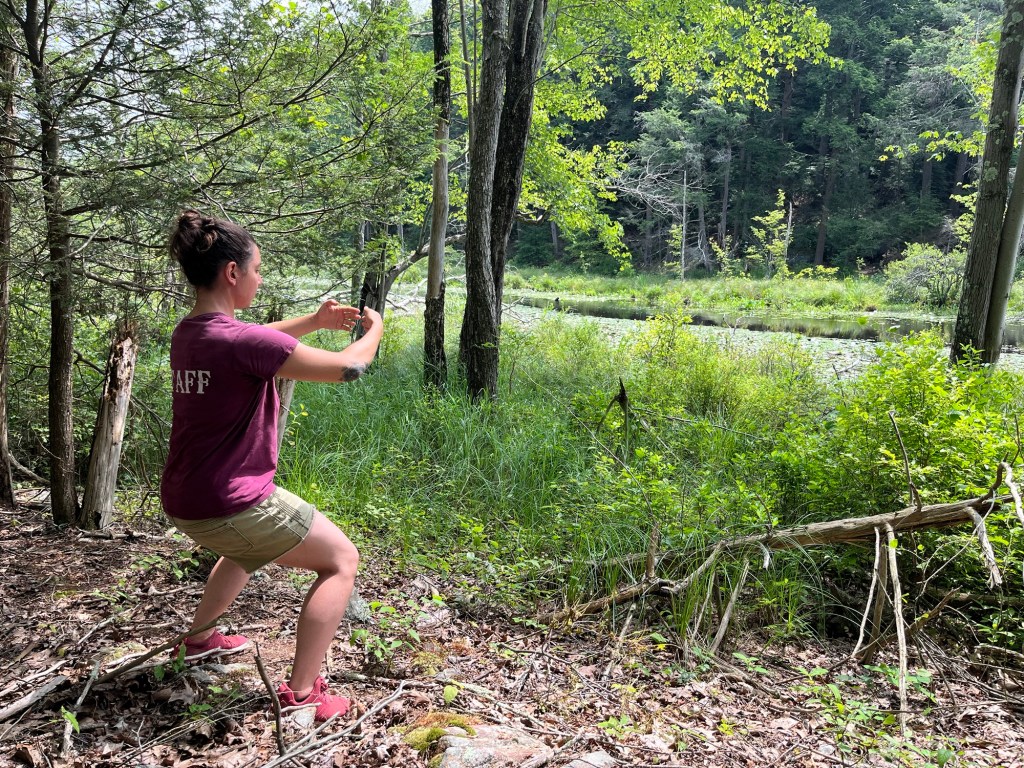
In Holding, or Embracing, the Tree, stand in the “wu chi,” position- translating literally to “without separation,” referring to the moment before distinction, a meditative moment of both emptiness and unity. The weight is evenly distributed between both legs. Feet are shoulder width apart and the second toes are parallel to each other. Ankles, knees and hips are folded softly, aligned so that the knees release forward over the toes but not past them.
The arms form a circle in front of your sternum. You may look into the palms of your hands as you extend all ten fingers towards each other, with about an inch between the longest fingers. As if they are trying to wrap around a tree trunk, this extension comes from the expansion of the upper back, scapulae spreading down and out like wings.
There are stories of practitioners from ancient China attempting to pull a tree up out of the ground with a thrust through the legs, tasked to prove their worthiness to study with a great master. Of course, on accomplishing the feat, they have already mastered tai chi and are no longer fit to be students.
Enduring this practice for long stands can lead to great changes, as the body learns where it is exerting unnecessary effort. Start with 5 minutes and increase gradually up to 45 minutes. Concentrate on diaphragmatic, or belly breathing. The legs may shake, which will encourage the big muscles and habitual patterns to let go, giving way to more to more refined, intrinsic organization.
With a partner, your task is to hold your ground by yielding and directing the force down through your feet into the ground, while being pushed or pulled. Your partner will first push into your forearms. You should not become stiff, or collapse with their pushing. Your partner might let go suddenly, which will tell if you are resisting, leaning into the force, rather than absorbing the force. If the structure is collapsing, and the circle is shrinking, your partner can press inwards on both elbows slightly. Expand across the collarbones and out. Your partner may also try to pull you from this front position. Keep sitting into the fold of the hip joints.
A good partner will also be rooting as they push and pull, sending the force from the ground, through their center, into your center in a way that helps you to feel your structure. The person pushing is also developing their structure and ability to sense yours, and if their arms are doing most of the work this is less accessible. They should be able to start with a clear direction but very little pressure, and gradually pour on more pressure. Then they can try fluctuating unexpectedly, even move away completely.
When they push from the side, with one hand on the shoulder and the other on the hip, you should feel the diagonal axis down to the opposite foot very clearly. Last, they may test you from behind, by placing two fists right behind your navel and applying just enough pressure to unbalance you.
Rooting exercises like standing meditation and being pushed by a partner can be practiced in any posture. In fact, they should be practiced in every posture. Try doing the form and pausing for one minute in each posture. To further understand each of the other postures, which are no longer symmetrical, your partner tests you- “Don’t let me push you, don’t let me pull you,” and the person pushing will search for openings, or weak spots, through diagonal and curved vectors. There is a systematic method to this called the eight gates, which is an excellent illustration of the geometry of push hands, or tui shou. With experience, players build an understanding of these gates that is inherent in the game.
Standing still, balanced, relaxed and ready for movement in any direction, is essential at every stage of learning tai chi, and should not be forgotten regardless of advancement to new techniques.
…
This month’s article is a practical homework assignment, mostly instructional. I recommend tree standing either to begin your practice or begin your day. On a personal note, I learned this practice from my teacher, Daria Faïn , about ten years ago, and it is still the first root of my martial arts practice. A 45 minute stand was the test for my Iron Shirt Instructor certificate. This was my morning practice in my hotel room in Taiwan on the day of my World Championship. In addition to tree standing, Daria has taught me several meditations both standing and seated which made stillness core to my training regimen. Her next workshop is coming up this Saturday July 13th, at the same location as Taproot’s Sunday session in Soho, NYC. Please find more information here!
 Push Hands Now